
Glass Meal Containers Need a Separate Protection Review
A meal-prep bag that closes around a glass container has passed only part of the purchasing review. The container, lid, neighbouring items, base support and handling arrangement need their own protection assessment. Start with the actual container and the offered bag sample; do not infer cushioning or breakage resistance from a soft exterior or silver lining.
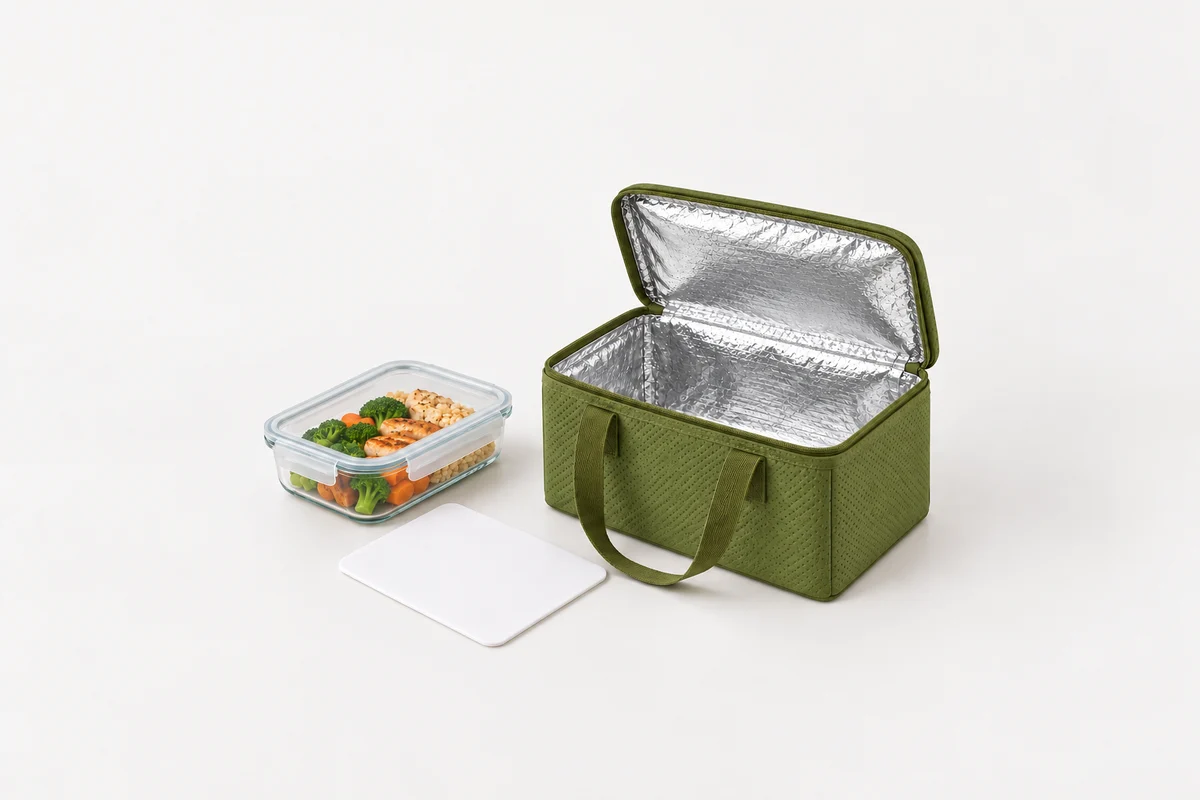
Begin with the offered single-compartment construction
YUANEN’s current olive meal-prep bag is a proposed upright design with a top zipper opening, body-mounted handles and one undivided silver-lined chamber. Its woven exterior, insulating layer and lining are confirmed through sampling. Separate compartments, a shoulder strap and fitted protective inserts are not specified features of that proposal. Containers and cold packs are props unless separately agreed for supply.
Identify contact and support points in the real arrangement
Assign an ID to each container and lid, noting material, external outline and filled weight. Describe what touches the bottom, sides and lid when placed in the intended arrangement. If several items are planned, record contact between containers, closures and any coolant component. A dimension or stacking check does not establish whether those contacts provide adequate protection during the intended handling.
- Arrangement record: container/lid ID ___; material ___; filled weight ___; base support ___; side/lid contact ___; neighbouring component ___; observation/photo reference ___; unresolved issue ___.
Define a protection proposal before changing the bag
Ask the buyer’s packaging-responsible team to define the protection requirement and any proposed separation, support or cushioning. Then ask the supplier whether that proposal is feasible and what it changes in the bag, usable opening or loading sequence. New dividers or padding remain options to assess, not features already supplied. There is no universal protective thickness established here.
Recheck the complete arrangement if a protective component is added: the container must still pass through the opening, rest as intended and allow closure without forcing its lid. Record the complete loaded weight and review the proposed support and handle arrangement with the supplier. A satisfactory fit still does not establish rated carrying load or impact protection.
Agree how the complete pack-out will be evaluated
Describe the intended lifting, hand-over, placement and transport sequence to the team responsible for evaluation. Agree the sample revision, conditions, acceptance criteria and method appropriate to that use. This guide does not prescribe a do-it-yourself drop or thermal-shock test. A visual observation record is a way to identify questions; it is not a completed protection or temperature-performance test.
Send YUANEN the container references, contact/support record, full loaded weight and proposed protection components with the enquiry. Confirm bag construction, cleaning expectations, accessories and supply scope against the agreed sample. Keep glass protection and temperature-control requirements distinct so that evidence for one is not presented as approval of the other.
Sources and scope
Check the cited sources. Product specifications are subject to order confirmation and the agreed sample. This article is not a product test report or a regulatory certification.