
IFCO expands reusable produce packaging at Whole Foods Market
IFCO announced on November 3, 2026 that it is expanding reusable packaging containers in Whole Foods Market’s US fresh produce supply chain. The purchasing issue is broader than replacing a cardboard box with a reusable crate: a usable empty container must find its way back to the next packing operation. The announcement describes that circulation process, but does not disclose the service terms a new buyer could obtain.
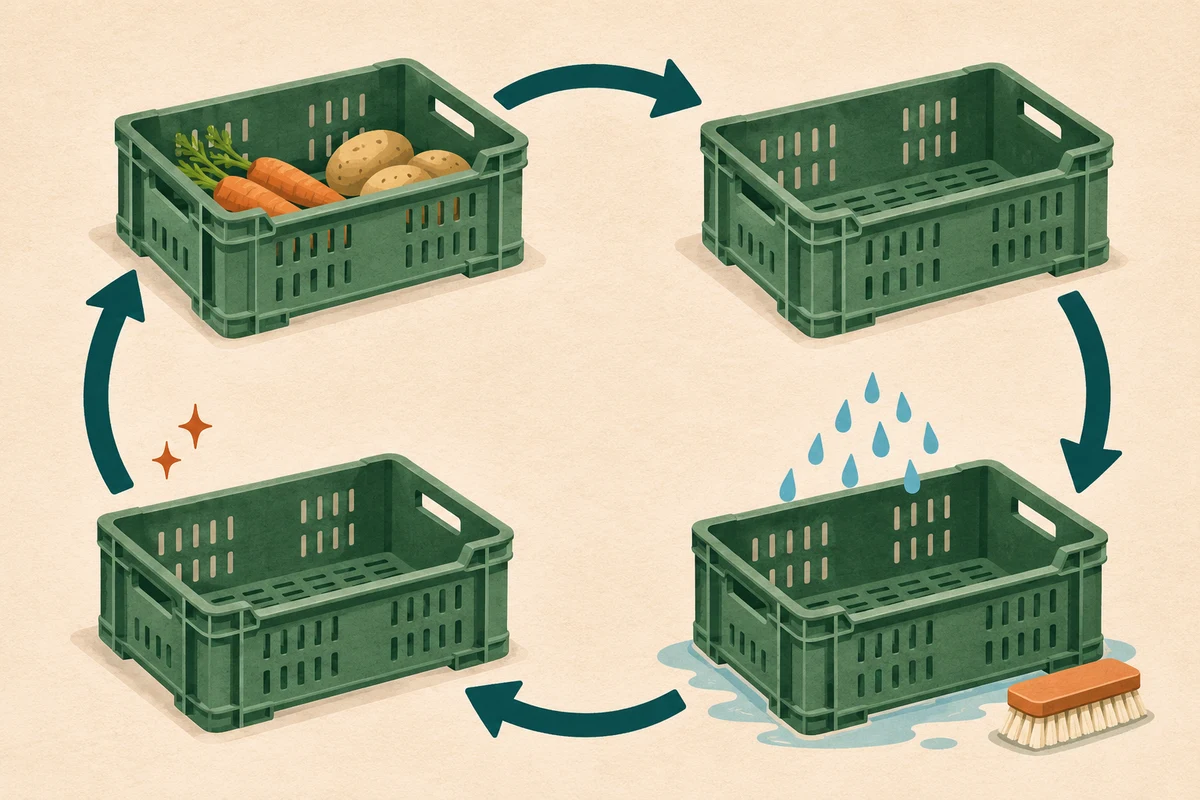
An expansion of a program that started in 2022
According to IFCO, the collaboration began in 2022. An initial pilot replaced single-use cardboard boxes with reusable crates for potatoes, onions, carrots and other root vegetables. IFCO says the pilot was followed by an agreement to broaden the program and convert additional fresh produce products. November 3 is the date of the expansion announcement; it is not the operational start date, and the article does not establish that conversion is already complete throughout the retailer’s supply chain.
Read the waste figure with its source and time period
IFCO reports that the program has avoided nearly 4 million pounds of cardboard waste since it began. That is a cumulative company-reported result for this collaboration, not an annual saving, a per-container result or a forecast for another buyer. The announcement does not provide enough calculation detail to independently reproduce that figure.
For an evaluation of another route, ask what one-way packaging is actually displaced, over which period and against which shipment records. Keep losses, replacement containers and return operations visible in the comparison. These are recommended evaluation questions; the announcement does not supply the corresponding route data or prove a net environmental or cost benefit for your operation.
The procurement question is how the loop closes
The original announcement says that IFCO crates are collected after use, washed and sanitized, and returned for reuse. Those steps explain why a reusable container program includes recurring movements and handovers as well as the physical container. Buying an object intended for repeated use does not, by itself, define who performs those tasks.
Before choosing a similar model, follow one shipment from packing to return. At the receiving point, establish who separates and holds the empties and who arranges collection. At the cleaning handover, identify who releases containers for the next use and how damaged or unsuitable units are handled. At the next packing point, establish who replenishes usable empties and what happens if returns arrive late. A gap in any handover leaves a task unassigned even when the crate itself suits the produce. These are buyer-side questions, not disclosed terms of the IFCO–Whole Foods Market agreement.
What this announcement can inform
The case is relevant when growers, distributors and retailers are considering a coordinated return system for produce transport packaging. If a proposed route has no agreed way to recover empties, first resolve that responsibility before treating reuse as an operating plan. If a return arrangement already exists, compare the proposed container and service against that actual route rather than assuming the same result as this announcement.
This report concerns reusable produce crates and their circulation. It is not evidence that YUANEN supplies IFCO containers or a pooling service, and it establishes no temperature-control performance for insulated bags. Any separate YUANEN product order remains subject to its own specification and sample confirmation.
Sources and scope
Check the cited sources. Product specifications are subject to order confirmation and the agreed sample. This article is not a product test report or a regulatory certification.