
Cup Dividers in Beverage Delivery Bags Need Room for Lids and Hands
A divider that holds a narrow cup may not leave enough room for its wider lid or for fingers to lift it out. YUANEN’s beverage delivery proposal combines a top-opening fabric tote with body-mounted handles and a proposed removable textile divider. The cell layout must be agreed around the actual filled cups; the illustrated cup count is not a capacity specification.
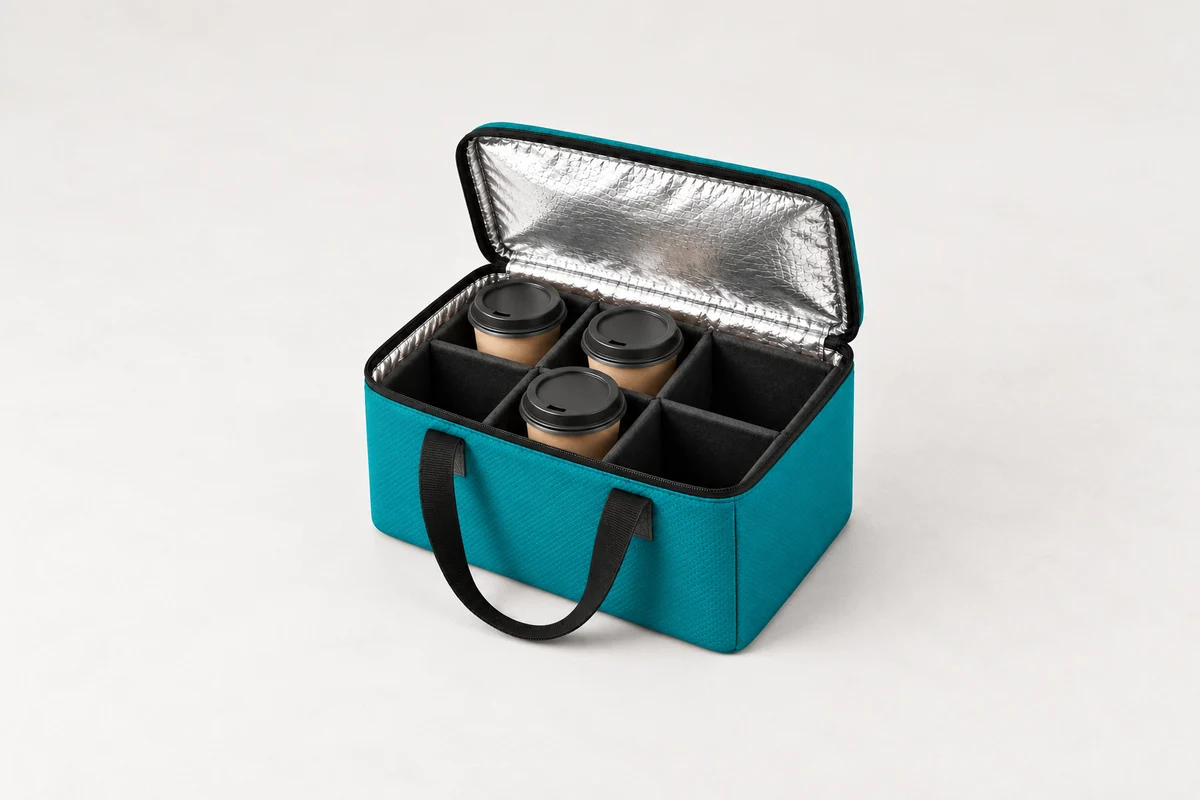
Build a cup-and-lid measurement list
Record each cup format with its fitted lid: base width, greatest lid width and total closed height. Include sleeves and protruding seals if used. Separate the dimensions of a filled cup from those of an empty nested stack. If two drinks use different lids, do not assume that the same cell works for both.
- Record: cup/lid references ___; base width ___; maximum lid width ___; closed height ___; filled mass ___; sleeve or seal ___; units ___.
Check the cell and the space above it
Place the filled, closed cups in the sample divider. Look for lid-to-lid contact and confirm that each cup can be removed without lifting its neighbour. Close the bag’s full zipper path and observe whether the lid or liner presses on the cup tops. A soft divider can change shape under load, so an unloaded cell drawing is not sufficient evidence of fit.
- Reject a layout that requires pulling on a drink lid to extract the cup. Note where fingers can grip the cup body and where the divider or zipper obstructs that grip.
Compare full, mixed and partial loads
Use three agreed arrangements in a controlled sample check: all intended cells filled, mixed cup formats, and only the cells needed for a small order. Inspect cup movement, base sag and handle balance in each arrangement. An empty cell is not necessarily a stable support for its neighbour. If a restraint or adjustable layout is needed, specify it as a proposed custom feature and test the revised sample.
- For each arrangement record: occupied cells ___; cup references ___; total load ___; movement observed ___; handle balance ___; removal result ___; sample revision ___.
Agree removal, cleaning and supply separately
Ask how the proposed textile insert is removed, cleaned, dried and refitted. Follow instructions for the agreed materials rather than assuming machine washing or waterproof construction. Refit the sample after the agreed cleaning procedure and repeat the cup fit check. Confirm whether the divider is included, supplied separately or still a design option. Neither the divider nor this checklist provides a spillproof or thermal-duration guarantee.
Send YUANEN the cup measurement list, three loading arrangements, handling requirements, divider proposal, order quantity and destination. Request a written sample specification before confirming an order. If the operation only needs lightweight outer drink packaging, compare the existing self-seal milk-tea bag instead of assuming this reusable-tote proposal is necessary.
Sources and scope
Check the cited sources. Product specifications are subject to order confirmation and the agreed sample. This article is not a product test report or a regulatory certification.