
Specify Carrying Loads Separately from Insulated-Bag Volume
Litres, tray count and a closed bag’s appearance do not define a carrying-load rating for insulated catering bags. Before ordering, record what the proposed pack weighs, what that figure includes and how the complete carrier is intended to be handled. Send that requirement separately from the dimensional-fit and thermal-performance brief.
Start with the actual carrying construction
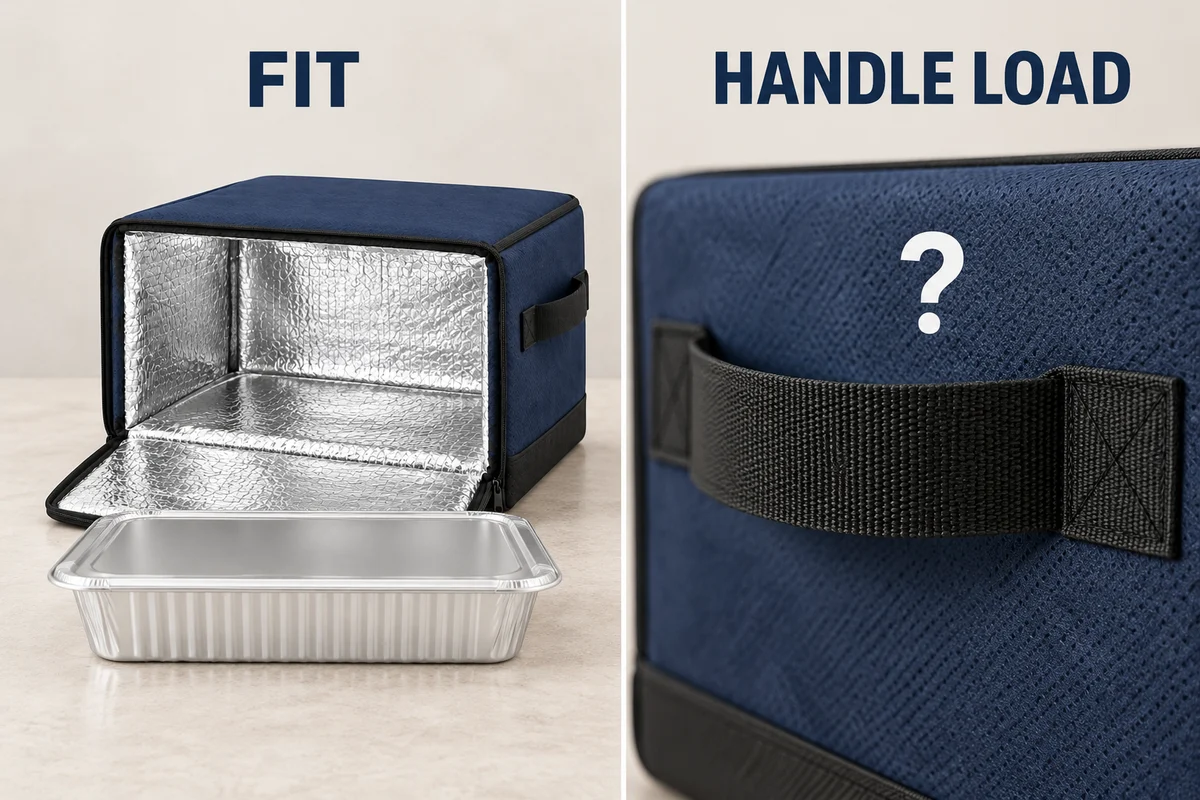
YUANEN’s current catering-carrier proposal has a navy non-woven exterior, aluminum foil lining, a front panel that folds down and short side grips for two-handed handling. Its published page requires sample confirmation of carrying loads and base support. It provides no fixed load rating. The open front flap is an access feature, not a confirmed load-bearing platform.
Identify the proposed bag revision and the handle, attachment, seam and base arrangements that belong to it. Do not add a shoulder strap, divider or rigid rack to the requirement as if it were already included. A photograph of trays in a bag is useful for discussing form, but cannot establish carrying strength.
Write down the mass basis before a total
Use a consistent unit and identify whether each entry is per item or a subtotal for the stated quantity. Record the actual proposed contents, rather than converting a litre figure into kilograms. If a measured filled-container mass already includes its food and lid, do not count those parts again.
| Item | Mass basis | Scope/reference |
|---|---|---|
| Containers and lids | Quantity ___; unit ___; per-item mass or subtotal ___ | Container/lid references ___; includes food: yes/no ___ |
| Food or other contents | Mass ___; included in a filled-container entry or separate ___ | Contents and packing state ___; avoid duplicate entry |
| Coolant and accessories | Item/quantity/unit/subtotal for each ___ | Actually proposed components ___; no assumed supply inclusion |
| Bag itself | Bag mass ___; included in requested total: yes/no ___ | Bag revision ___; contents subtotal and full-assembly basis separately named |
Give the verification plan a defined scope
Describe the proposed layout, which components sit together and how the carrier is supported and moved. Link the intended handling to the current side grips, base and seams. Keep uncertain arrangements open for supplier review rather than testing an unknown load by lifting it yourself.
Ask the supplier or qualified testing party to agree the method, conditions, acceptance basis and report scope for the proposed complete bag and use. No test weight, cycle count or universal programme is prescribed here.
- Verification brief: bag/handle/base/seam version ___; defined mass and inclusion basis ___; proposed arrangement and handling ___; responsible reviewer/tester ___; agreed method/conditions ___; acceptance basis ___; applicable report/sample references ___; open items ___.
Keep the resulting claim within the evidence
A component test does not establish the complete bag’s rating, and a sample that can be lifted once does not establish durability under repeated use. A mechanical bag rating also does not decide whether a person can safely carry that pack alone; handling arrangements need their own review. Do not turn this brief into an overload, hanging or drop-test exercise.
Send YUANEN the completed mass record, proposed carrier revision and verification questions. Confirm samples, responsibility and order terms in writing. Dimensional fit, leak containment and temperature performance remain separate checks. The empty carrier and separate tray on the cover show form only; they provide no rated capacity, test result or promise that a tray is supplied.
Sources and scope
Check the cited sources. Product specifications are subject to order confirmation and the agreed sample. This article is not a product test report or a regulatory certification.