
Define the Packaging Use Before Requesting Food-Contact Documents
A request for a food-contact document is easier to assess when it identifies the component and intended use. For a foil-lined shipping box, distinguish the food’s existing wrapper, the separate liner and the outer box before asking which supporting documents cover each part. A silver surface or an insulated-packaging name does not answer that question.
Draw the contact path for the actual pack-out
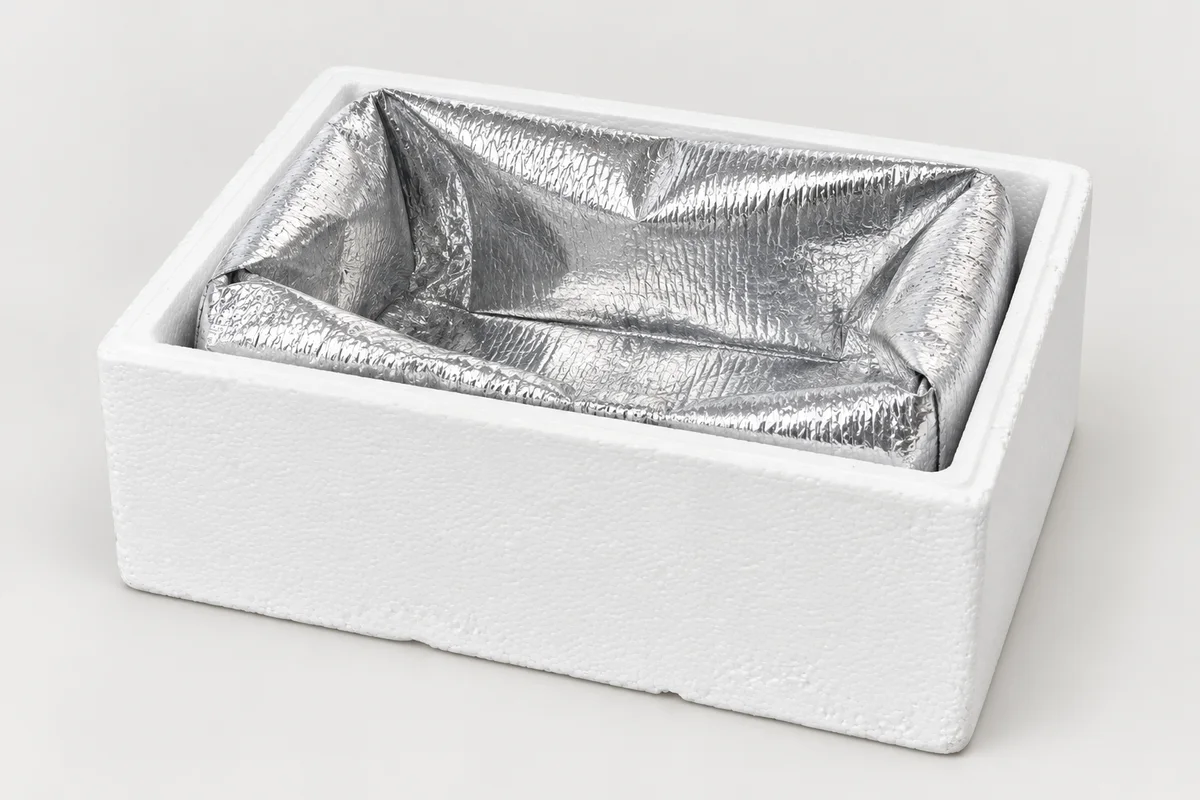
YUANEN’s current box-liner reference shows a separate silver liner inside a white foam outer box, with top material folded over the load. For your enquiry, describe what is actually placed inside it. Identify whether each surface is intended to touch the food itself, a closed food container, another wrapper or a coolant component. Record any uncertain contact as a question; do not assume that an intervening wrapper removes all assessment needs.
- Contact record: component ID ___; material as confirmed by supplier ___; facing surface ___; item it touches ___; sample/revision ___; contact uncertainty ___.
Describe the use rather than selecting a certificate by name
The FDA publishes reference tables separating food types and conditions of use for food-contact-substance notifications in the United States. Those tables help explain why “food packaging” alone is too broad a description; they do not approve this liner or determine the applicable requirements for your finished pack. Have the responsible supplier or qualified reviewer assess the actual use and documents.
Our suggested brief records the intended food or closed food package, contact temperature and duration, storage and handling stages, single-use or return-cycle plan, destination market and any intended cleaning. State uncertain conditions as unresolved. Do not copy the conditions from a different product’s document merely to make the request look complete.
Map each document to a component and sample revision
Ask what the document identifies: material, component or finished article; supplier or manufacturer; sample description; tested or declared scope; conditions and limitations; and issue or revision reference. Compare those fields with the offered construction. YUANEN’s public document collection includes records with specific material and test scopes. A cotton-fabric record or an RPET heavy-metals report cannot be treated as proof for a different foil liner.
- Document match: component/sample ID ___; file and revision ___; supplier-confirmed coverage ___; intended condition covered ___; gap ___; reviewer and next action ___.
Keep a gap open until the relevant party resolves it
For example, a buyer may describe sealed food pouches inside the liner and a separately specified coolant. The supplier still needs the actual contact map and use conditions to explain what its documents cover. If the offered liner, adhesive, wrapper or use changes, identify what must be reviewed again. A useful enquiry returns a matched scope or a precise outstanding question, not an unsupported “FDA-certified” or direct-contact assurance.
Send the use brief with the liner enquiry and ask YUANEN to confirm the offered layers, usable dimensions, closure allowance and sample reference. The foam box, food packages and coolant are separate supply questions. This guide is a procurement record, not a compliance decision, product approval or completed food-contact test.
Sources and scope
Check the cited sources. Product specifications are subject to order confirmation and the agreed sample. This article is not a product test report or a regulatory certification.