
Specify Moisture Contact for Paper Insulated Bags
A reflective interior does not answer where water may reach a paper insulated delivery bag. For a cold-container handoff, describe the condition of the container exterior and the surfaces supporting the bag before asking for a moisture-resistance claim. Keep this enquiry separate from thermal duration or a dry carrying-load rating.
Start with the current open-top construction
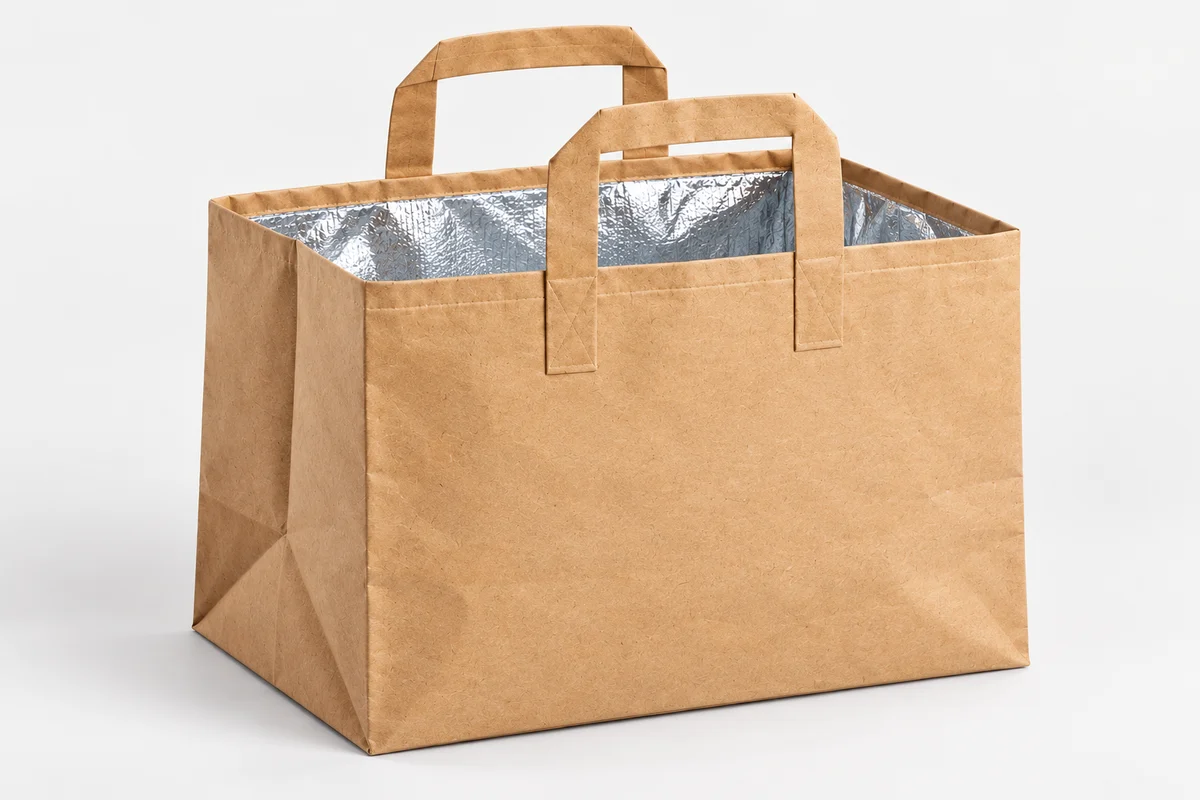
YUANEN’s published paper-bag proposal uses a kraft-paper exterior, reflective inner layer, wide flat base and short flat paper handles. The top is open. Full layers, bonding and handle attachments still require confirmation with a physical sample. It is a custom design proposal, not evidence of tested wet strength or a sealed shipping pack.
Name the contact location rather than writing only “waterproof paper bag”. A closed food container can have a different external condition at packing and at handoff. If surface moisture is expected, describe it without assuming the liner protects every paper edge, base fold or handle joint. Do not assume that either a paper exterior or a reflective face contains a liquid leak.
| Location | Describe the use | Keep with the sample |
|---|---|---|
| Container exterior and inner base | Dry or surface-wet when packed; intended contact points | Actual closed container and proposed arrangement |
| Lining edge and gusset folds | Where moisture could reach a paper edge or joint | Actual layer and joint construction, not a silver-surface assumption |
| Outside base and counter | Proposed supporting surface and contact period | Agreed complete-bag evaluation and acceptance basis |
| Paper handles and attachments | Handling sequence and possible wet contact | Handle/joint revision and responsible reviewer |
Separate paper evidence from complete-bag evidence
TAPPI’s public T 456 description concerns tensile strength of paper or paperboard saturated with water. That defines a material-test scope; this article does not provide or prescribe the full method. A result for an identified paper specimen would still need to be tied to the offered paper grade and conditions. It would not, on its own, establish the finished bag’s wet carrying performance.
For the proposed bag, ask the supplier or qualified testing party to agree which contact conditions, complete assembly, contents, handling and acceptance criteria are relevant. Keep the paper reference, lining/bonding revision and handle/base construction in the same record. A different paper or attachment needs review before copying an earlier claim. Do not improvise a soaking-and-lifting test on an unknown load.
Send the contact brief with the enquiry
Send YUANEN the closed-container reference, expected exterior condition, contact-location table and proposed handoff sequence. Mark material, sample and evaluation questions that remain open. Confirm the quoted construction and supply scope in writing. This guide gives no wet-load limit, waterproof classification, thermal duration, food-contact approval or recyclability claim. The dry empty bag on the cover shows the design form only.
Sources and scope
Check the cited sources. Product specifications are subject to order confirmation and the agreed sample. This article is not a product test report or a regulatory certification.