
Specify Tote Handle Drop Separately from Strap Length
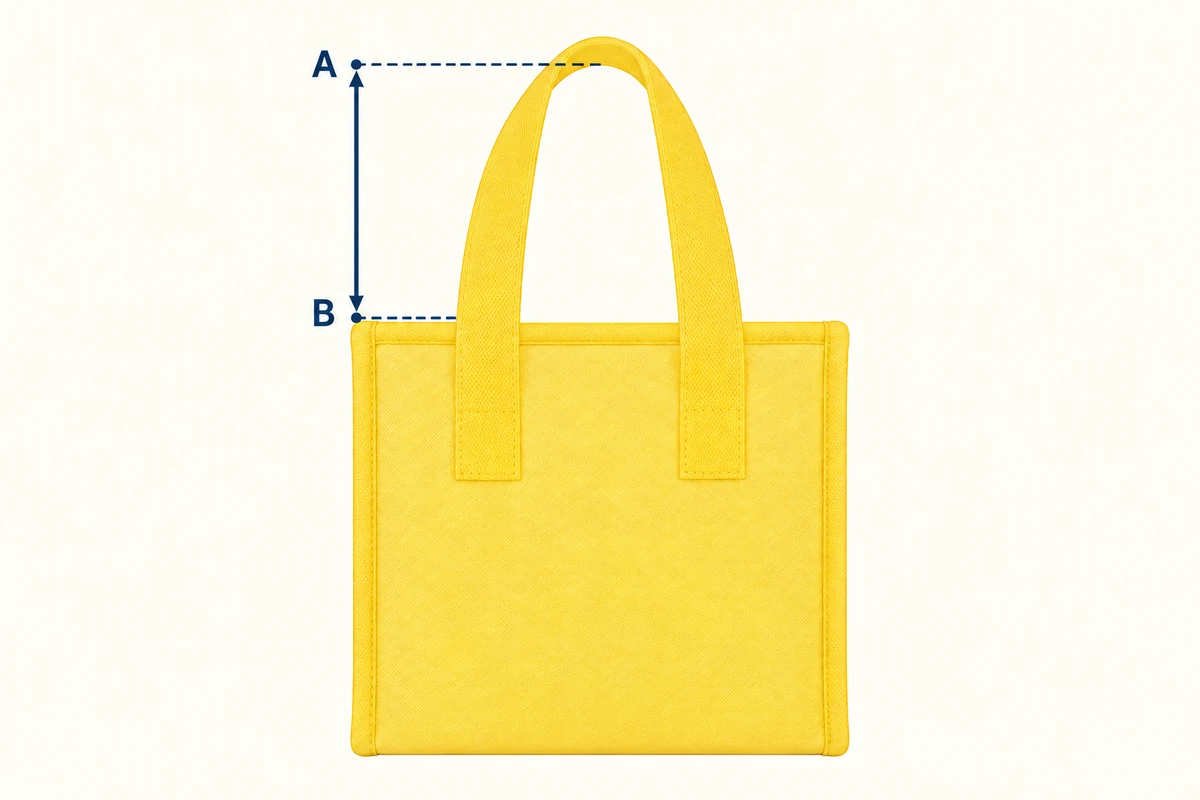
A tote bag handle drop describes an opening height; a quoted handle length may describe a different path. When ordering an insulated lunch tote, ask for a marked drawing instead of treating those figures as interchangeable. The yellow YUANEN sample makes the distinction visible because its webbing continues down the front of the bag.
Name the distance you want compared
For the dimensional brief shown here, agree a straight vertical distance from the selected top edge of the bag opening to the highest inside point of the raised handle loop. The drawing marks those references B and A. It shows the opening between them, with no measured size or universal fit recommendation.
The webbing length follows the handle material rather than that straight line. Ask whether the supplier’s quoted length includes the parts stitched onto the body, hidden ends or only a stated free section. A stitched-down segment below the rim is not part of the vertical opening above it. Do not obtain the drop by simply halving a handle-length quotation.
Agree the reference points and sample state
Use the actual bag and handle revision. Identify which handle is being measured, which opening edge is the lower reference and whether the upper reference is the inside or outside edge of the handle. Keep the chosen convention consistent between the drawing, sample record and quotation. Note how the bag is supported and how the loop is raised, without stretching it to achieve a desired figure.
- Request separately named fields: bag/sample revision; A/B reference drawing; vertical drop and units; webbing-length definition and units; handle width; attachment positions; sample state; agreed tolerance if applicable. Leave unconfirmed entries open.
Keep dimensional agreement separate from carrying approval
YUANEN’s compact lunch-bag page asks buyers to agree handle drop, attachment points and zip access with a sample. It does not give a fixed handle-drop dimension or prove shoulder clearance. State the intended grip and carrying mode, any relevant clothing or gloves, and whether handles must stay clear while opening the zip. Ask for a sample review matching that use rather than approving fit from the diagram alone.
A clearance measurement establishes no carrying-load rating, attachment strength or thermal performance. Agree safe handling and the relevant mechanical evidence separately before any loaded carrying review. A change to the handles, body or attachment arrangement needs its own review against the proposed order.
Sources and scope
Check the cited sources. Product specifications are subject to order confirmation and the agreed sample. This article is not a product test report or a regulatory certification.