
Inspect Where Tray Corners Meet the Foil Lining
Dimensional fit does not describe every contact inside an insulated catering bag. A raised lid corner or rolled tray rim may meet a lining fold or seam during loading and removal. For YUANEN’s current navy front-opening carrier proposal, make these contact locations part of sample review alongside the actual tray-and-lid combination. The result is a record of what was observed, without assuming an abrasion or puncture rating.
Give the tray, lid and bag their own references
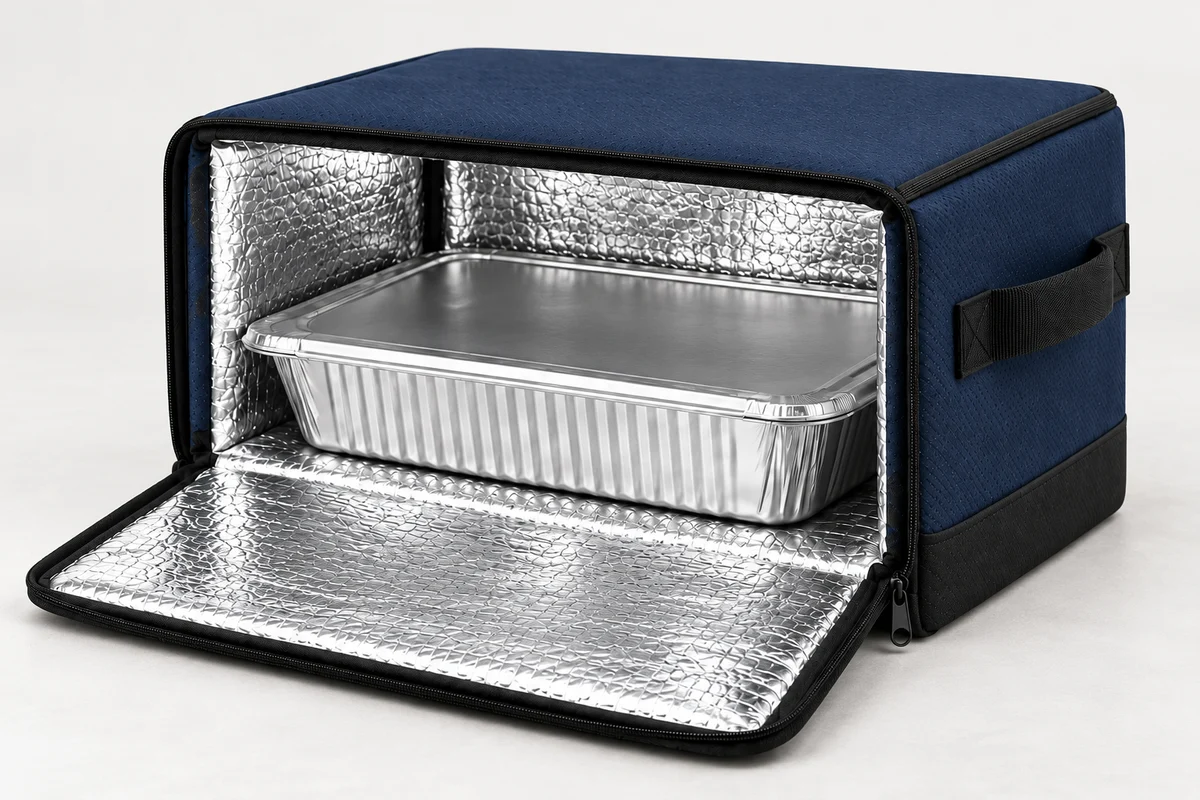
Use the actual tray and fitted lid intended for the order. Record raised corners, clips and rolled rims as well as the greatest closed dimensions. Give the bag sample its own revision reference. The current YUANEN proposal has non-woven outer fabric, aluminum foil lining, a fold-down front and short side grips; it does not specify an internal rack or a protective insert.
- Sample record: bag revision ___; tray reference ___; lid reference ___; maximum closed dimensions ___; intended load and orientation ___; starting photographs ___.
Map contacts along the actual loading path
With the sample supported on a stable surface and the front fully open, observe the lidded tray moving horizontally through the opening under the agreed handling arrangement. Identify where its corners or rim meet foil folds, seams or the zipper surround. Then observe removal, since the lid can meet a different area on the way out. Do not force a rim past an obstruction.
Use a consistent orientation in the record, for example left and right as viewed from the open front. Link each contact-point code to a photograph or sketch and the named tray corner. This can be documented on a separate drawing; it does not require marking, piercing or attaching something to the foil lining.
- Contact record: point code ___; tray corner/rim ___; lining fold/seam/zipper area ___; loading or removal ___; photo/sketch ___; obstruction observed ___.
Compare the same areas before and after handling
Agree the sample load, handling sequence and number of repetitions with the responsible team before starting. Photograph the identified areas beforehand and afterwards from comparable angles and lighting. Record changes in folds, visible rubbing, seam condition or foil damage without turning a single photograph into a service-life claim. Keep the original images with the sample references.
If the tray catches, a seam opens or the lining is visibly damaged, stop the sample sequence and ask the responsible team and supplier to assess it. Retain the affected sample and record the step where the change appeared. This guide does not recommend patching or repairing the lining, and observation alone does not establish a standardized test result.
Review any proposed separator as a change to the pack-out
Send YUANEN the sample references, contact map, before-and-after photographs and agreed handling record. If an insert or separator is proposed, describe it as a custom option still to be confirmed. Recheck the space it occupies, tray removal and closure, and ask the responsible team to assess its material and intended-use requirements. It is not an included or already qualified feature of the current proposal.
The cover shows a lidded tray inside an open carrier. The tray is a prop; no wear trial is pictured. Confirm construction and tray fit by sample, and evaluate carrying load, durability and complete-pack-out temperature performance separately under an agreed plan.
Sources and scope
Check the cited sources. Product specifications are subject to order confirmation and the agreed sample. This article is not a product test report or a regulatory certification.