
Match Insulation Roll Bore and Diameter to Receiving Equipment
A roll can have the requested material and length yet still be unsuitable for the buyer’s unwinding arrangement. Start with two sets of information: the equipment owner’s documented receiving limits and the supplier’s proposed finished-roll specification. Do not treat a core-size description as the diameter of the complete roll.
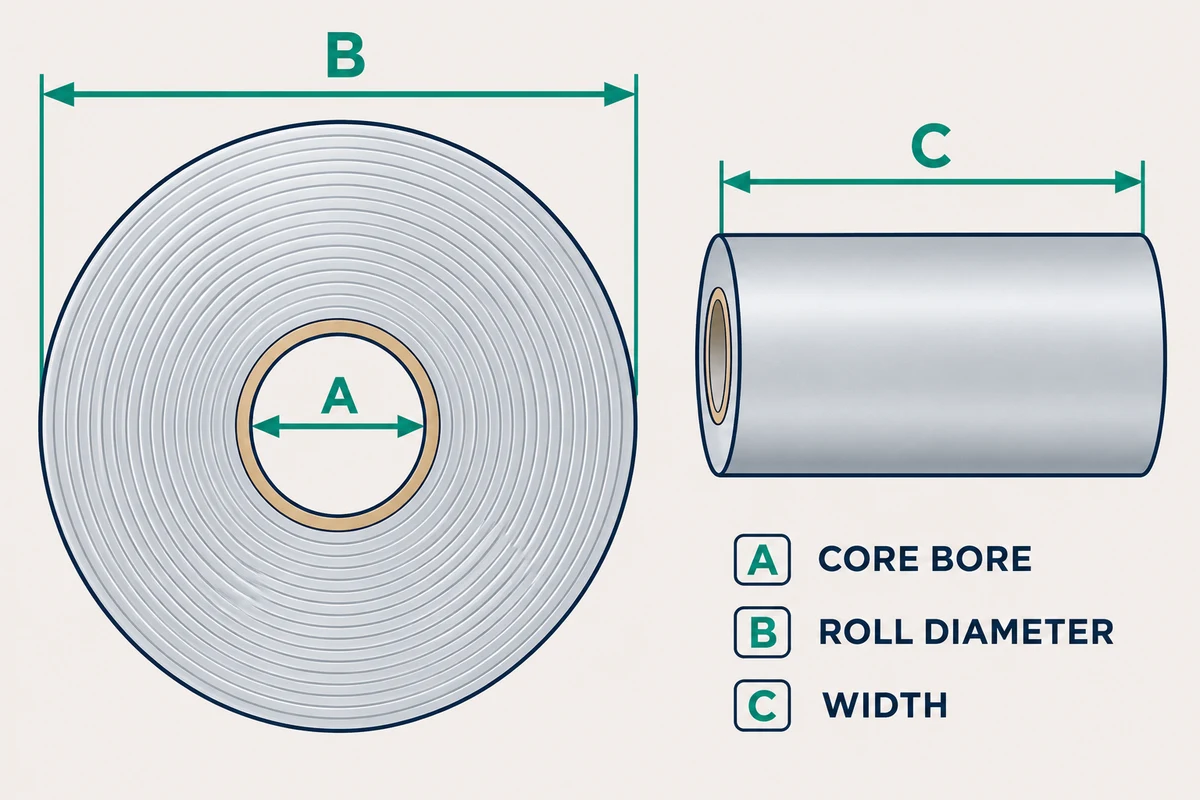
Identify which circular boundary a dimension refers to
The core bore is the open inside diameter through which a compatible shaft or chuck arrangement must fit. The bare core’s outside diameter includes its wall. The finished-roll outside diameter reaches the outermost wound material. These are separate dimensions; a core supplier’s outside diameter is not the finished roll diameter. Identify them on the drawing rather than relying on an unexplained “diameter” entry.
Roll width is a separate axial measurement. Confirm whether the quoted width means usable material width and whether the core projects beyond the material ends. A width that fits the working area does not by itself confirm mounting fit or clearance for the complete roll.
Compare the equipment requirement with the actual supply proposal
YUANEN’s EPE foam foil rolls and foil bubble insulation rolls both require core bore, roll diameter and handling mass to be confirmed separately from usable width and length. They are different material constructions. Neither page establishes a universal core size or guarantees compatibility with the buyer’s machine. Use the following as a handoff record, not as a machine operating procedure.
| Item | Equipment owner supplies | Supplier confirms |
|---|---|---|
| Mounting | Required bore/interface and core-end arrangement | Proposed core ID, construction and projection |
| Envelope | Admissible full-roll diameter and width | Finished-roll OD, usable width and overall width |
| Handling | Documented receiving/handling restrictions | Mass of the actual proposed roll and packing |
Resolve mismatches before choosing the roll length
Do not infer the final outside diameter from nominal length alone, or assume that an EPE roll and a bubble roll of the same length occupy the same space. Ask for the proposed finished-roll diameter and mass for the actual construction. If the proposal exceeds the receiving limits, ask whether a different agreed roll format or cut sheets are appropriate; availability and resulting quantities require a revised quotation.
At receipt, compare the identified roll with the agreed drawing and delivery record before arranging use. Let the equipment owner define safe lifting, mounting and operation; a photograph or a successful dimensional comparison is not a load rating, machinery approval or thermal test. Confirm tolerances, inspection method and supplied accessories in the order.
Sources and scope
Check the cited sources. Product specifications are subject to order confirmation and the agreed sample. This article is not a product test report or a regulatory certification.